
A crack you filled last year that has opened again, water pooling against the wall for days after the rain, a chimney starting to lean off the house. From Price Hill over to Hyde Park we handle basement waterproofing, foundation repair and french drain installation, and the inspection is free.
Get Your Free Inspection
We appreciate you reaching out.
One of our team members will be with you shortly.




WHAT TO LOOK FOR
Cincinnati is a hill city, and the ground those hills are made of loses strength when it gets wet. Most of the time it moves slowly enough that you only notice what it leaves behind. These are the ones we get called about most.
Something under it is still moving
You filled it, and a year later it is back in the same place. That is not a repair that failed, it is ground that kept going.
It has nowhere else to go
A puddle that sits along the wall for days after the rain stops, or ground that stays soft. On a slope, everything above you drains past your house.
The wall has been shoved
Cracking that runs up through the mortar in steps instead of straight down. The width matters less than whether it has moved since you last looked at it.
It is going on its own
A gap between the chimney and the wall it is meant to sit against. A chimney carries its own weight, so it moves first when ground shifts.
The slope is taking it with it
A gap opening where the porch meets the brick, always on the downhill side. The house is staying put and the ground beside it is not.
It found a way in
Water along the bottom of the wall after a wet week. A basement cut into a hill has wet ground on more sides than a flat one.
You might have just one of these. Plenty of houses on these hills have three or four. A crack that keeps reopening, a leaning chimney, a downhill side that is dropping. Those usually all point at the same thing, which is a slope that has not finished moving. Water on the basement floor is a different problem with a different fix. Telling those two apart is the first thing we do, and it costs nothing.
A crack somebody has filled twice already, a chimney that has started to lean off the house, water on a basement floor after a wet week. Those are the calls that come in from around Cincinnati. Tap any service to see what the work involves.
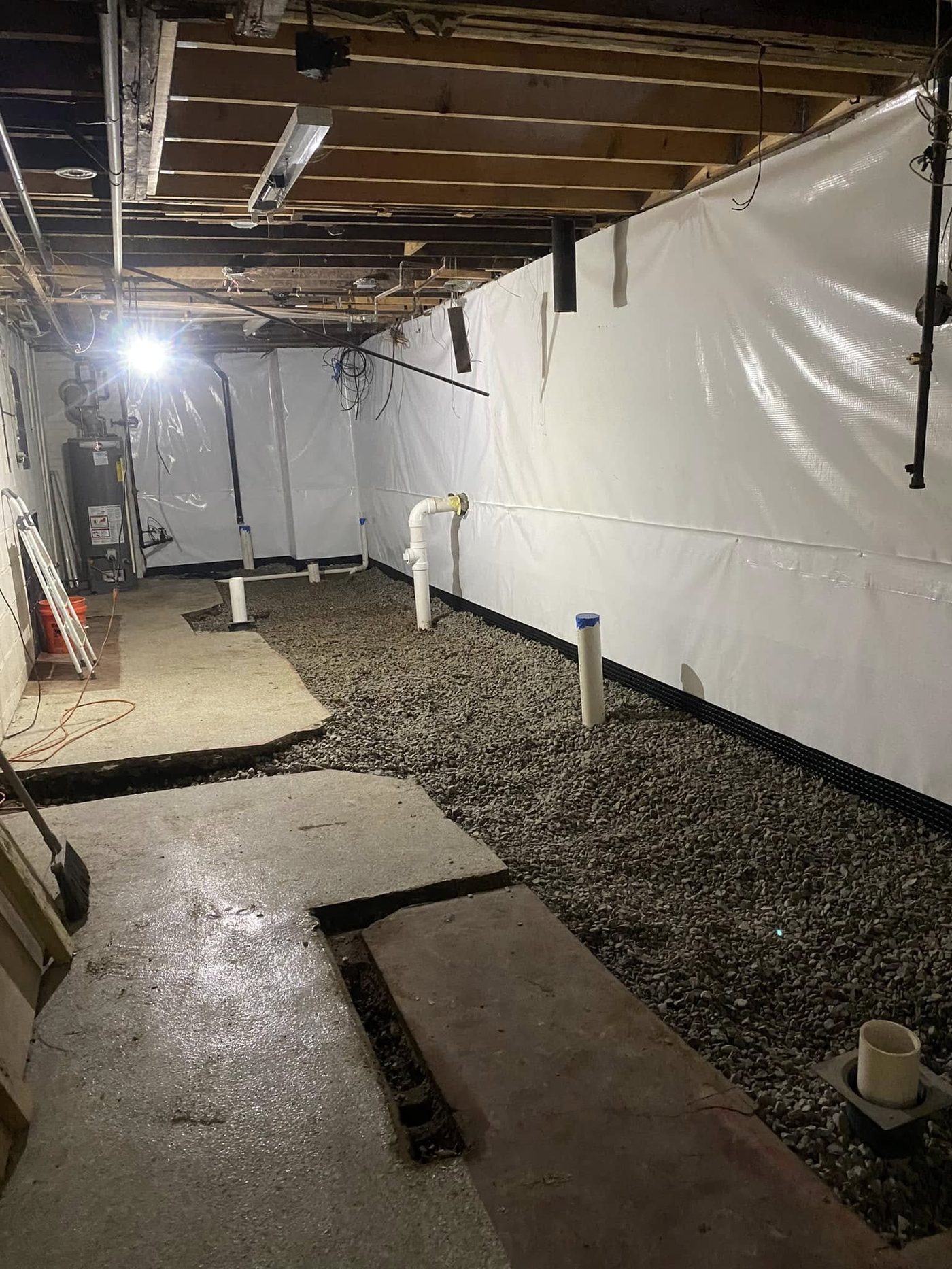
Keeps water out of a basement cut into a hillside, where there is wet ground on more sides than a flat lot ever has.
Learn moreWalk into a basement in Price Hill and you are not standing in a box in flat ground, you are standing in a box cut into a hill. That means wet ground stacked against the uphill side and very little against the downhill one, and water arriving from a direction that makes no sense if you are standing in the yard.
The work follows the water rather than the wall. Grading and downspouts get corrected first, because on a slope a badly aimed downspout does more damage than it would anywhere flat. Inside, a drain at the footing collects what still gets through and carries it to a pump. On the uphill wall, where the ground is genuinely saturated and the site allows a dig, a membrane goes on the outside face. A pump and a sealed discharge finish it, because collected water has to leave.
Sealer on the inside is the thing that fails, because it treats the surface while the pressure carries on behind it. In Northside the grading was most of the job. The inspection is free. Ask what the plan does with the water, not what it puts on the wall.

Intercepts water traveling down the slope toward the house and routes it past and away, before it ever reaches the footing.
Learn moreOn a slope every drop that lands uphill of your house eventually comes past it. In Clifton that can mean water from three properties away arriving at your footing, which is why people cannot work out where it is coming from by looking at their own yard.
A french drain gets in front of it. A trench is cut across the uphill side, perforated pipe goes in wrapped so fine material cannot silt it up, and it beds in washed stone laid to fall. On a slope there is usually plenty of fall to work with, which makes this a better-value job here than in a flat city. It discharges well clear and downhill of the house, with cleanouts so it can be flushed rather than dug up later. Depth matters as much as line, since a trench that stops short of the wet layer only catches what was already running on top.
It will not stop the slope moving, and it is not a substitute for a retaining wall that has had enough. In Hyde Park the downspouts were most of it, and we said so.

Carries a footing that has moved back onto ground that holds, which on a hillside means going deeper than the layer that shifts.
Learn moreGround on a Cincinnati hillside does not fail all at once. It creeps, and the top few feet creep most, which is why a footing that was fine for eighty years can start moving now. In Mount Adams that shows as a crack that reopens rather than one that simply appears.
Foundation repair puts the load below the layer that is moving. Piers are driven or turned down until they reach material that is not going anywhere, and brackets transfer the house onto them. The lift comes back in stages, watched as it goes, so old brick and plaster travel with it instead of tearing. On a slope the depth matters more than the count, because a shallow pier in creeping ground is just a deeper version of the same problem. Interior work and drainage usually go in alongside it, because dry ground moves far less than wet ground does.
It does not stop the hillside, and nobody can. What it does is take your house out of it. In Walnut Hills that meant piers on the downhill side and drainage above. We come out and look before anyone quotes.

Lifts what the drainage collects up and out, which on a hillside basement is usually more water than people expect.
Learn moreA basement cut into a hill gathers water from uphill whether you like it or not, so the pit fills more often than it would on level ground. In Corryville that is why a pump that would be oversized elsewhere is about right here.
A pit is cut at the low point and lined so the surrounding ground cannot wash in. The pump sits on a solid base rather than in the silt, and the discharge runs well clear of the house and downhill, with a check valve so what goes out does not run back. A sealed lid keeps the humidity in the pit instead of the room. A battery backup matters because the storms that fill a pit take the power with them. Two pumps in one pit is not overkill on a lot that collects from above.
The discharge point is the part that gets rushed on a slope, and putting it out onto the hill above a neighbor is how you make an enemy. In Oakley most calls turn out to be a worn pump. We will check yours for nothing.

Seals a crawl space off from ground that stays damp, so the moisture stops working its way up into the house.
Learn moreBasements dominate here, but on a steep lot a rear addition often sits over a crawl space instead, tucked into the hill. Those stay damp because the ground around them does, and air moves up out of them into the house. In Madisonville that is what people are smelling.
Encapsulation closes that path. A heavy liner goes across the ground and up the walls, sealed at the seams and fastened rather than tucked, and the vents get closed so outside air stops cycling through. Where the ground is genuinely wet a drain and a pump go in first, because sealing over standing water only hides it. A dehumidifier holds the space afterwards, sized to the volume rather than guessed. Rim joists get sealed too, since that is where most of the outside air was getting in.
It is not insulation and it will not lift anything. What it does is stop the crawl space feeding damp into the rooms above it. In Westwood the drain went in first and the liner second. Having yours looked at costs nothing.

Closes the cracks that are worth closing, and works out first whether the ground behind them has actually stopped moving.
Learn moreHere more than most places, injecting a crack without asking why it opened is money thrown at a symptom. On creeping ground the same line comes back, and people blame the resin. In Pleasant Ridge the useful first question is always whether it has changed since it was last filled.
Where the movement has genuinely stopped, resin injected under pressure fills the crack right through to the outside face and leaves no void for water to sit in. Where it has not, carbon or steel goes across it so the two sides stop working against each other, and the ground or the drainage gets dealt with before anything is injected at all. A crack gets measured and marked first, then looked at again weeks later, because a number taken twice is worth more than any opinion taken once.
That order is the whole difference between a repair that lasts and one that does not. If yours has been sitting unchanged for a decade we will say so rather than sell you a repair. In Northside two of three cracks we were called out to had not moved in years, and we told them so.
Queen Foundation Repair handles the thing that goes wrong under most Cincinnati houses: hillside ground that loses its grip once it is wet and carries on moving after the rain has stopped. We are a leading provider of foundation work across the city, covering basement waterproofing, french drain installation, foundation repair and sump pump installation.
Most of what we get called to started small. A crack somebody filled a year ago that has opened again, a chimney beginning to lean off the house, a porch dropping away on the downhill side. Left alone those get more expensive, because the slope keeps working on them.
So we look before we quote. From Price Hill across to Hyde Park, someone comes out, goes over the property and down the basement, and tells you plainly what is happening and what putting it right involves. The price is in writing before work starts. If it is cosmetic, we will say so rather than sell you a repair you do not need.
A lot of the houses here are cut into a slope, so one basement wall is holding back a hillside while the others are barely holding back anything. You can see everything Queen Foundation Repair does across Ohio. Licensed and insured, the warranty moves with the house if you sell, and the estimate is free.
Get your free inspection
WHAT YOU GET
We pick up quickly and get out to the property fast, so you're not waiting weeks to learn what's wrong and what it costs.
No charge for us to come out, work out what's happening, and lay out what the fix involves. You know where you stand before deciding.
Licensed, with full liability and workers' comp cover, so the work meets code and your property is protected if anything goes wrong.
Every repair carries a written warranty that passes to the next owner, so it protects the value of the house if you sell.
A clear written price before anything starts. No vague ballpark, and nothing new appearing once a crew is already on the job.
From the hillside houses through Price Hill to the flatter streets out past Oakley, we are down these basements every week.


COMMON QUESTIONS
What it costs, whether a hillside is something to worry about, why a basement floor gets wet with nothing leaking, and what insurance actually covers. That is most of what comes up on the phone here.
What It Costs
It depends on how much of the wall needs doing and where the water is getting in. Interior drainage with a pump is the usual job and lands in the low thousands, priced by the foot of wall. Digging the outside and putting a membrane on costs a good deal more, and on a steep lot it is not always possible. Grading and downspout work is often a few hundred. Which one you need is what an inspection is for. Foundation repair pricing in this market follows the structural scope, not the size of the home.
Sealing a crack that has stopped moving is usually a few hundred dollars. Piers under a settled corner run into the thousands, because the price follows how many go in and how deep each one has to reach. On a hillside they generally go deeper, so the same number of piers costs more here than it would on flat ground, Two quotes on the same house can differ by a lot for that reason. Anyone pricing it before they have seen it is guessing. Basement waterproofing and interior drainage carry their own line, and the concrete work is quoted separately.
Less than most people expect, if the cause is outside. A downspout run well away from the house is a few hundred dollars and fixes a good number of damp basements. A dehumidifier sized to the room is a few hundred more. It climbs once drainage and a pump are involved. Start at the cheap end. Load-bearing integrity is what we are protecting, and the walls tell us how far the issues have gone.
Hillsides and Moving Ground
Being on a slope is not the same as being in trouble. Cincinnati has genuinely unstable ground in places, and the city maps it, but most hillside houses sit there for a century without incident. What matters is whether anything is changing now: a crack that reopens after it was filled, a retaining wall that has started to lean, ground pulling away from a patio on the downhill side. Those are worth having looked at. A steep back yard on its own is not a problem, and nobody should tell you it is. Waterproofing solves the water side; concrete repair handles what the water already did to the home.
Because the ground behind it has not finished moving. Filling a crack repairs the wall, not the reason the wall split. On slow-moving ground the same line opens again a year or two later, usually to about the same width and in the same place. That repetition is the useful signal, and it is worth more than the width ever is. A crack that keeps coming back is telling you to deal with what is behind it before anyone injects anything else into it. Foundation cracks that keep widening are the ones worth acting on, and the walls usually show it first.
It is worth taking seriously. A retaining wall is holding a slope back, and once it starts to tilt it does not correct itself. How urgent it is depends on what sits above it and how quickly it is moving. Mark the top edge, measure across to something fixed like a fence post, write the date down, and check the same measurement in a month. If the number has changed, get it looked at rather than waiting to see what the next wet spell does to it. Our foundation contractors price each scope from the inspection, never from a phone call.
Water in the Basement
A little humidity in an old basement is normal. Water running across the floor is not. The line is whether it arrives with the weather. A basement that only smells damp in August has a ventilation problem. One with water along the wall after every heavy rain has a drainage problem, and that does not settle down by itself. Waterproofing a home here usually pairs with a sump system and a discharge line. Basement waterproofing done properly keeps the walls dry for good.
Because it is coming up through the joint where the floor meets the wall, not through a hole you can point at. When the ground outside is saturated it pushes water into the lowest opening it can find, and on a hillside lot the uphill side stays wet long after the rain has stopped falling. There is nothing there to patch, which is why sealing the floor never works. The fix is giving that water an easier route than the one through your basement. Movement in older homes tends to start at the walls and work outward from there.
If you are using the space or planning to, yes. Dry basements hold their finish, and a wet one takes the joists and the stored boxes with it over time. If the basement is bare storage and gets damp twice a year, grading and downspouts may be all it needs. The honest answer depends on what the room is for. Basement waterproofing is the permanent version of that fix; concrete patching alone is not. Waterproofing the home from inside is what stops the issues coming back.
Walls and Cracks
Some are and most are not. Fine vertical lines in poured concrete are normal shrinkage and turn up in almost every basement. Stair-step cracking through block, a crack wider at one end, or one you can slide a coin into is worth a look. So is any crack that has changed. Width alone tells you less than movement does. Expert foundation crack repair services start with finding what moved, not with sealing the surface.
By whether it moves. Put a pencil mark at each end, write the date beside it, measure the width with a ruler and note the number down. Look again in three months. If nothing has changed, it is doing nothing. If it has widened or the ends have travelled, that is real movement and worth a proper look. Waterproofing and structural repair are two different budgets, and we itemise both.
Because the ground takes a while to catch up with the weather. Rain has to soak in, work down and sit there before anything shifts, so the door that stops shutting and the crack that opens a little wider turn up a week or two after the wet spell rather than during it. That gap is why people so rarely connect the two, and why most of these calls come in once the sky has already cleared and the yard looks fine again. Home value follows structural integrity here more than almost any other repair.
What the Work Involves
Interior drainage on an average basement is usually two to three days, and the pump goes in the same week. Grading and downspout work is often a single day. An outside dig takes longer and depends on access, which on a steep lot can decide it. You get a real schedule once someone has seen the site. Concrete that has settled gets lifted; walls that have bowed get braced. Concrete leveling handles the slab once the walls are stable.
Usually not. Most of this work happens inside, along the base of the basement wall, and the yard is left alone. A french drain or an outside membrane does mean a trench, and on a slope the route matters more than the length. When digging is the right answer you are told where and why beforehand. Waterproofing issues left alone become bigger issues, and the cost curve gets steep. Waterproofing a home early costs a fraction of repairing the walls later.
Generally yes. Ohio's residential code treats a finished basement as living space, which brings in egress, ceiling height, smoke alarms and anything you touch in the electrical or plumbing. Cincinnati handles its own permits through the city. It is worth checking before the work rather than at resale, when an unpermitted bedroom becomes somebody else's problem to price. Foundation repair in this market runs from crack injection to full basement waterproofing systems.
Insurance and Selling
Almost never. Standard homeowner policies exclude groundwater and surface water, which is what nearly all of this is. They may cover damage from a sudden burst pipe, and a separate sewer backup rider covers a backup if you carry one. The waterproofing itself is treated as maintenance, the same way a roof replacement is. Read the water exclusions in your own policy rather than going on what a neighbor was told about theirs, because the riders people carry vary more than the base policies do. Every home is different, so the walls and the concrete both get inspected before we price anything.
Rarely. Movement from soil, settlement or a slope is excluded on standard policies as gradual rather than sudden. The exceptions are narrow: damage from a plumbing leak under the slab is sometimes covered, and so is a vehicle or a fallen tree. Filing tells you where you stand for nothing, but plan on paying for the repair yourself. Waterproofing keeps the home dry; structural work keeps it level. Most jobs need some of each.
Ohio requires a written residential property disclosure form, and it asks directly about water in the basement and about structural problems. You disclose what you actually know, including past repairs and how they held up. Sellers get into trouble for what they knew and left off the form, not for having had work done. A documented, permitted repair with a receipt reads far better to a buyer than a blank line does, and it tends to survive the inspection contingency instead of reopening the price. Call us today and the inspection covers the walls, the concrete, and the drainage around the home.
WHERE WE WORK
We cover Hamilton County and the whole Greater Cincinnati area, not just the addresses close to downtown. Hillside lots and flat ones, old basements and newer builds, and plenty of houses where the fix turns out to be a downspout. If a house needs looking at, someone comes out and looks at it.
ZIP CODES WE COVER
Ready to Get Started?
No obligation, fast and easy.
We appreciate you reaching out.
One of our team members will be with you shortly.


